Feedback isn't what you think it is
A feedback conversation is only one node in a structure. Whether it produces what it is designed to produce depends on conditions that had to exist before the meeting and on commitments that have to follow it.

Most managers treat the feedback conversation as the unit of analysis. Did it go well? Was it skillful? Was it timely? Those are legitimate questions, but they are the wrong starting point. The conversation is one node in a structure. Whether it produces what it is designed to produce depends on conditions that had to exist before the meeting and on commitments that have to follow it.
This edition maps that structure. It also introduces a connection that most organizations treat as separate but cannot afford to: the relationship between performance feedback and career development. In the ideal system, those two conversations are wired into each other at specific points. When they are not, the feedback cycle is developmentally incomplete.
Performance feedback is the visible output of a structure
Every employee is expected to receive performance feedback, and every manager is also expected to give it to their team. However, a feedback conversation is not an isolated event; it is merely one point in a larger sequence, and its actual value depends entirely on what happens before and after.
What needs to happen before
The following conditions need to be in place to ensure the feedback conversation is meaningful.
Expectations
The employee needs to know what is expected of them, specifically enough to be able to assess their own performance against those expectations. Vague or unstated expectations become a source of misunderstandings and conflict.
Resources
The employee needs to have had the authority, resources, and organizational support required to do the work they are being evaluated on. Feedback on performance the employee was not empowered to deliver is not feedback. It is a failure of leadership disguised as an evaluation.
Visibility
The manager needs genuine sight lines into the work, not just its outputs. Evaluating outcomes without understanding the conditions under which they were produced is not assessment. It is measurement without context.
Dialogue
The feedback conversation should not be the first time the employee hears that something is not working. Ongoing dialogue before the formal conversation is what makes the feedback recognizable rather than surprising.
What needs to happen after
A path forward
The conversation has to result in a clear, specific account of what needs to change and how. Ideally that account is built together. But regardless of how it is arrived at, it is the manager's responsibility to ensure it exists, is focused on the right target, and is unambiguous. Feedback without a path forward is a diagnosis without a treatment plan.
Support
The path forward is only meaningful if the employee has what they need to walk it. That may mean adjusted conditions, access to resources, coaching, or simply a manager who stays present to the work rather than returning to it only at the next review cycle. A path forward without support is an instruction without the means to follow it.
Follow-through
Consequences, positive and negative, actually exist but they don't always materialize. If exceeding expectations produces nothing and falling short produces nothing, the structure has no integrity. Employees learn what a system actually values not from what it says but from what it does. And yet consequences are often the part of the structure managers are most reluctant to engage with. When the consequences are positive, a manager may lack the authority to make them happen — a raise, a promotion, a meaningful change in role. When they are negative, the concern is often about damaging the relationship or demoralizing the employee.
Avoiding the conversation about consequences does not mean consequences are not happening. It means the manager has lost control of what they communicate. Consider a team member who is consistently underperforming and is not held accountable. The manager avoids the conversation about consequences, believing they are protecting the employee. What they are actually doing is making a structural decision that affects everyone else. The rest of the team notices. They absorb the additional work. They begin to question whether their own effort matters. Trust in the manager erodes, not because of anything the manager said, but because of what the structure communicated through its silence. Disengagement follows. The consequence was never avoided. It was simply redirected toward a different target.
The Career Development conversation
There is a second conversation that belongs in this structure, and most organizations treat it as separate. The career development conversation is not a supplement to the performance feedback cycle. In the ideal system, it is wired into it at specific points.
Who conducts the career development conversation — the direct manager, a skip level, or both — varies across organizations and models. What matters structurally is that whoever holds that conversation is in genuine communication with whoever sets expectations and manages follow-through.
The first connection is at expectations
When a manager sets expectations, those expectations should reflect not only what the current role requires but what the employee's development goals make relevant. If an employee is working toward a promotion or a transition to a different kind of role, the expectations conversation is where that context belongs. What does performing at the next level look like in this role, right now? That question belongs upstream, not in a separate annual conversation about career aspirations.
The second connection is at follow-through
When an employee is exceeding expectations, the follow-through should reflect that. A stretch assignment, a higher-visibility project, an opportunity to demonstrate readiness for the next level — these are not rewards. They are structural responses to performance data. When an employee is not meeting expectations, their development trajectory is affected by that too. The career development conversation cannot be insulated from what the feedback cycle is actually producing.
Treating these as separate tracks is itself a structural failure. It produces managers who have career development conversations in January and set expectations in February as though the two events are not connected. The connection is real and it has to be structural, not based on a schedule.
The diagram below shows the full structure.
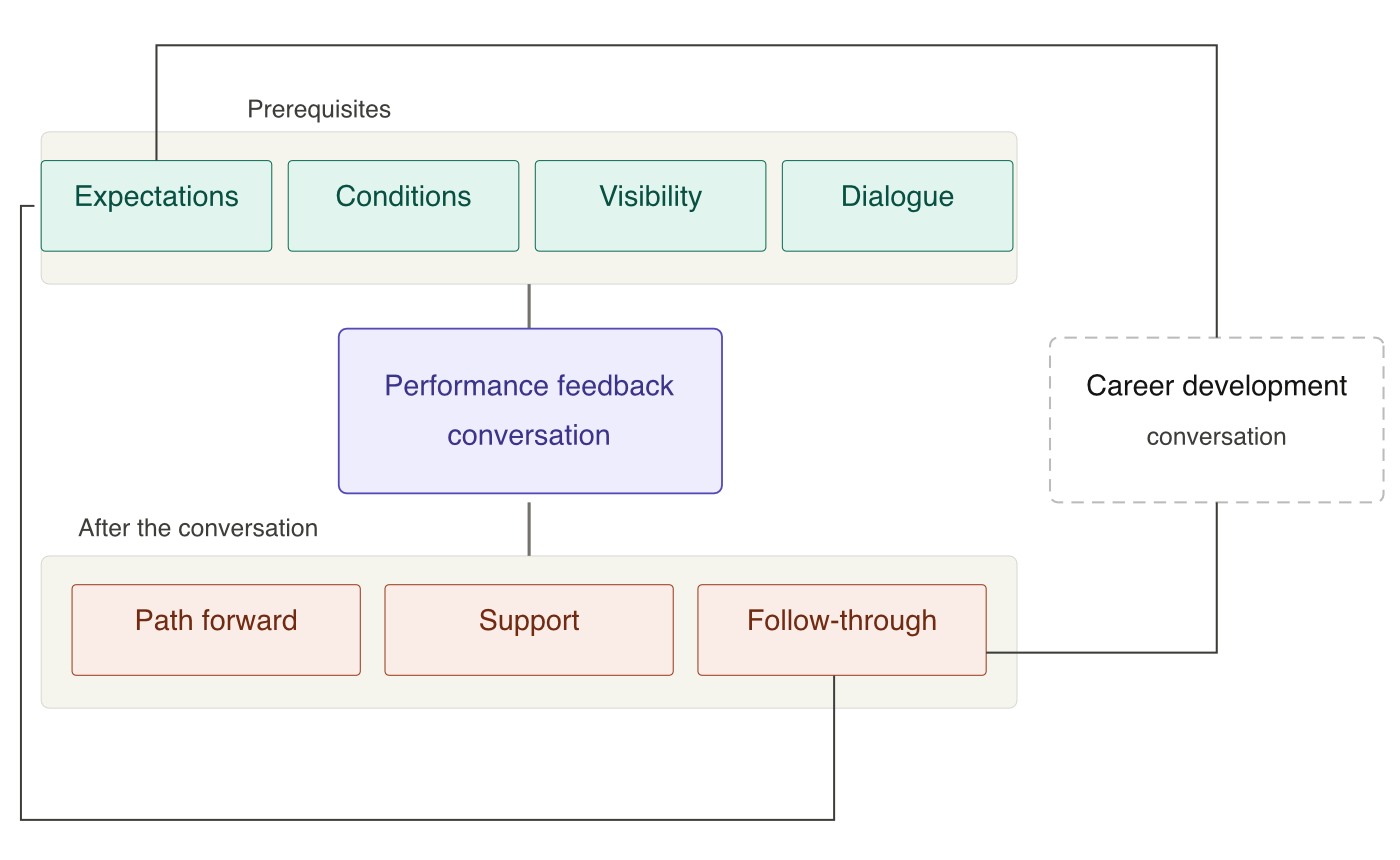
Performance feedback is not just a conversation; it is a node in a structure. The structure is what determines whether the conversation produces anything valid.
The upstream conditions — clear expectations, real conditions to perform, genuine visibility, ongoing dialogue — are what make the feedback accurate and fair. The downstream conditions — a path forward, genuine support, follow-through with real consequences — are what make it actionable. The career development conversation, wired into the structure at the right points, is what makes it coherent over time.
When any part of that structure is missing, the problem is not the feedback. It is the system that produced it. A more skillful conversation will not fix a structural failure. It will simply make the failure harder to see.
These structural requirements are not a "nice to have". They are what the system needs to function as intended, regardless of how any particular organization prefers to operate. The useful question is whether your current structure is actually built to produce what you intend it to produce.
Alexander Spradling, PhD, is an organizational consultant and executive coach based in Austin, Texas. He writes Why Organizations Misbehave.