You can be right about what an employee is doing and wrong about why

This edition follows one manager whose boss reads his struggles as a leadership gap, and offers a two-stage test for finding what is actually producing a problem and where the leverage to change it resides.
Riley manages a team of eight. His boss has three concerns about him. A cross-functional project he shares with his peer has been stalled for months. His team’s morale is sliding. He rarely meets with them, so feedback, alignment, and updates happen in passing or not at all.
His boss has a diagnosis: Riley needs to grow as a leader. He lacks confidence and executive presence, and should develop those qualities.
Most of us have seen some version of this. Many of us have been Riley, or his boss. The diagnosis is familiar, so it sounds reasonable. It points at something real, yet it rarely explains the real cause of what's being observed.
Understanding the real cause behind these observations requires looking beneath the surface. This article outlines a framework to help diagnose those hidden factors.
Step One: Describing the observed behavior, and identifying what that observation can and cannot tell you
The boss's diagnosis is persuasive because it rests on behaviors they can see. When asked where his team is headed, Riley hedges. When his peer pushes back on the shared project, he doesn't commit. He often arrives at discussions underprepared. "Lacks presence" and "lacks confidence" are inferences drawn from those observations, and because the observations are accurate, the inferences sound reasonable.
However, what the observations can't tell you is how much control Riley has over the conditions that shape his behavior. He hedges about direction because no one has explained the reasons behind the latest priority changes. He can't commit on the project because, as currently structured, he would be held accountable for outcomes that benefit his peer's metrics at the expense of his own. He arrives underprepared because his calendar is full. While Riley can influence some of these factors, he has no control over most of them.
When underlying conditions are hidden, one might easily assume Riley's behavior stems from personal shortcomings rather than his environment. The default response — coaching, development plans, or confidence training — misdiagnoses the issue. That's why before launching remedial actions, it is critical to pause, recognize that the picture is incomplete, and gather the information required to understand what is actually going on.
Step Two: Assessing whether an individual explanation fully accounts for the behavior
Ask these two questions:
- Does the explanation describe specific behaviors you've actually seen or have evidence they occurred?
- If it does, does the explanation say what is producing the behaviors, or does it take its conclusions for granted?
Riley's boss can name specific behaviors: the hedging, the reluctance to commit, the underpreparation. Here, the answer to the first question is "yes". The answer to the second question is "no", because it doesn't actually explain what is producing the behaviors, and because it takes for granted that the behaviors are due to qualities Riley lacks. Until an explanation passes both, it is not yet a diagnosis. It is a reason to look further.
Step Three: Evaluating the structural conditions shaping behavior through a two-stage root cause analysis
A structure is any recurring pattern in how work is organized that shapes behavior, regardless of who occupies the role. Structural explanations may be harder to notice because they're not as obvious and concrete as individual explanations. Yet what they point at can be found, named, and possibly changed.
The two questions above only tell you where an individual explanation fails to account for the problem. If that is the case, you must determine what is actually driving the behavior by conducting a two-stage root cause analysis.
Executing this analysis matters because mistaking a structural problem for an individual gap comes with a heavy cost. It wastes time and resources on solutions that cannot fix the root issue, while simultaneously burning out good employees who experience the fallout as stressful and unfair.
Determine if structure is contributing to the problem in a meaningful way by asking the following questions:
- Does the problem persist if you change who's in the role? If it does, the problem is inherent to the role itself, not the individual.
- Has the problem persisted despite genuine effort to solve it? Effort that doesn't move a problem is evidence about the problem, not about the effort.
- Do others in comparable positions show the same pattern? One struggling manager is a question about that manager. Several in parallel roles is a question about the roles.
Sometimes the answer is “no” because no structure is contributing in a meaningful way. A person may lack a skill that that a well designed role clearly requires, and training closes the gap. But when the answer is yes, you don’t need to ask all three questions. Finding a clear “yes” to just one proves structure is at play. Once you establish that, you move directly to stage two to find the leverage.
Determine where the leverage resides by asking the following questions:
Which conditions would have to change? Which role holds authority over them? Is that also the role being held accountable?
Leverage is the point where a change would actually alter the outcome. Answering these questions identifies what a fix would require, who's able to make it, and who is accountable for the result (if it's not the same role).
The two-stage root cause analysis applied to Riley
Applied to Riley, the analysis examines separately the three issues that his boss is concerned about: the stalled project; his team's sliding morale; no time to meet with this team.
The stalled project
Riley won't commit when his peer pushes back. The reality is that they are both measured on different metrics, and the project needs both of their functions. On some decisions that his peer supports, Riley can't agree because the outcome would undermine his numbers, and he would be held accountable for the failure. Neither manager can overrule the other, and nothing in how the project is set up, resolves the conflict for them. Each acts reasonably from inside their own mandate, and the project stalls.
Determine if structure is contributing to this problem in a meaningful way.
Would this problem persist if you changed who is in Riley's role? Yes. If you swapped Riley for another manager tomorrow, the new manager would hit the exact same wall. The answer to this question already establishes that the problem isn't the person occupying the role; it's how the role is structured.
Determine where the leverage sits.
Which conditions would have to change, which role holds authority over them, and who is accountable for the decision? The condition that has to change is how decisions get made when metrics compete. The authority to make that change sits with whoever oversees both functions. And that is not Riley. Presumably, that is also the role accountable for the decision. If it isn’t, then the accountable role needs to be identified and included into any problem solving process designed to prevent the project from stalling.
His team’s sliding morale
Riley's team has seen its priorities change several times this year. Each change pulls people off work they cared about and were deep into, and the reasons for the changes are rarely given. When the team raises a concern to senior leaders, they are assured they've been heard, but nothing changes. Trust erodes, and morale follows. Riley hedges when his team asks where they are headed because he doesn't know either.
Determine if structure is contributing to this problem in a meaningful way.
Does this pattern persist regardless of who is in Riley’s role? Yes. Suppose Riley left and someone else took his job. Priorities would keep changing without explanation, and concerns would keep going unanswered. When the same gap appears at two levels, it isn't coming from the person at either level.
Determine where the leverage sits.
Which conditions would have to change, which role holds authority over them, and who is accountable for the decision? To fix the morale issue, three conditions have to change: how often priorities shift, whether the reasons are given, and whether solicited input visibly affects a decision. Authority over all three sits with senior leaders. Yet, Riley is being held accountable for restoring trust in decisions he didn't make, can't change, and was never given the reasons for. Presumably, these are also the roles accountable for the fix. If they aren’t, then those roles need to be identified and included into any problem solving process designed to fix the morale problem.
Note that if Riley knew what the reasons were for the changes, and met his team’s concerns with silence, the test would place part of the leverage with him. The answer depends on the facts, not on the lens.
No time for his team
Riley is undeniably busy. His boss and stakeholders hand him a steady stream of projects, which he points to as a reason he rarely meets with his team and arrives at discussions underprepared. His explanation is structural, and it is partly true.
Determine if structure is contributing to this problem in a meaningful way.
Do others in comparable positions show the same pattern? In this case, no. Other managers with comparable demands still manage to meet with their teams, so the workload alone doesn't explain his absence.
Determine where the leverage sits.
Which conditions would have to change, which role holds authority over them, and who is accountable for the decision? Here, the facts point back to Riley. His team has the skill and capacity to take on more. What's missing is a structure for delegating work to them. Because Riley handles tasks that could be delegated to his team, and that time comes out of the time he could spend with them, the condition that has to change is how work is divided. Authority and accountability for that belong clearly to Riley. So, here, the leverage is his.
How the issues interact
- The low morale on Riley's team comes partly from the churn and from senior leaders’ silence on the team’s concerns. His lack of time to meet with his team reinforces it.
- A team that rarely meets with its manager has nowhere to make sense of changes that arrive without reasons. Riley's lack of time, in turn, comes partly from the demands set above and around his role. It also comes partly from the delegation structure he hasn't built.
- Riley also has some leverage over the effects of low morale. He can carry his team’s concerns upward, share what he knows, and shield people from some of the churn. That leverage is real but it is different from leverage over the causes, which he doesn't have.
- Would the morale problem persist if someone replaced Riley? Some of it would. His successor might find time for the team, but the churn and the silence would remain.
- Riley's boss was right to some extent about his diagnosis. Riley is accountable for part of the problem, but that part is a missing delegation structure, not a lack of presence or confidence.
- The stalled project runs on a different track, but the lack of clarity about how to solve the underlying conflict, and the time it takes to argue unproductively with his peer takes out valuable time, and reinforces the perception that Riley lacks leadership skills and executive presence.
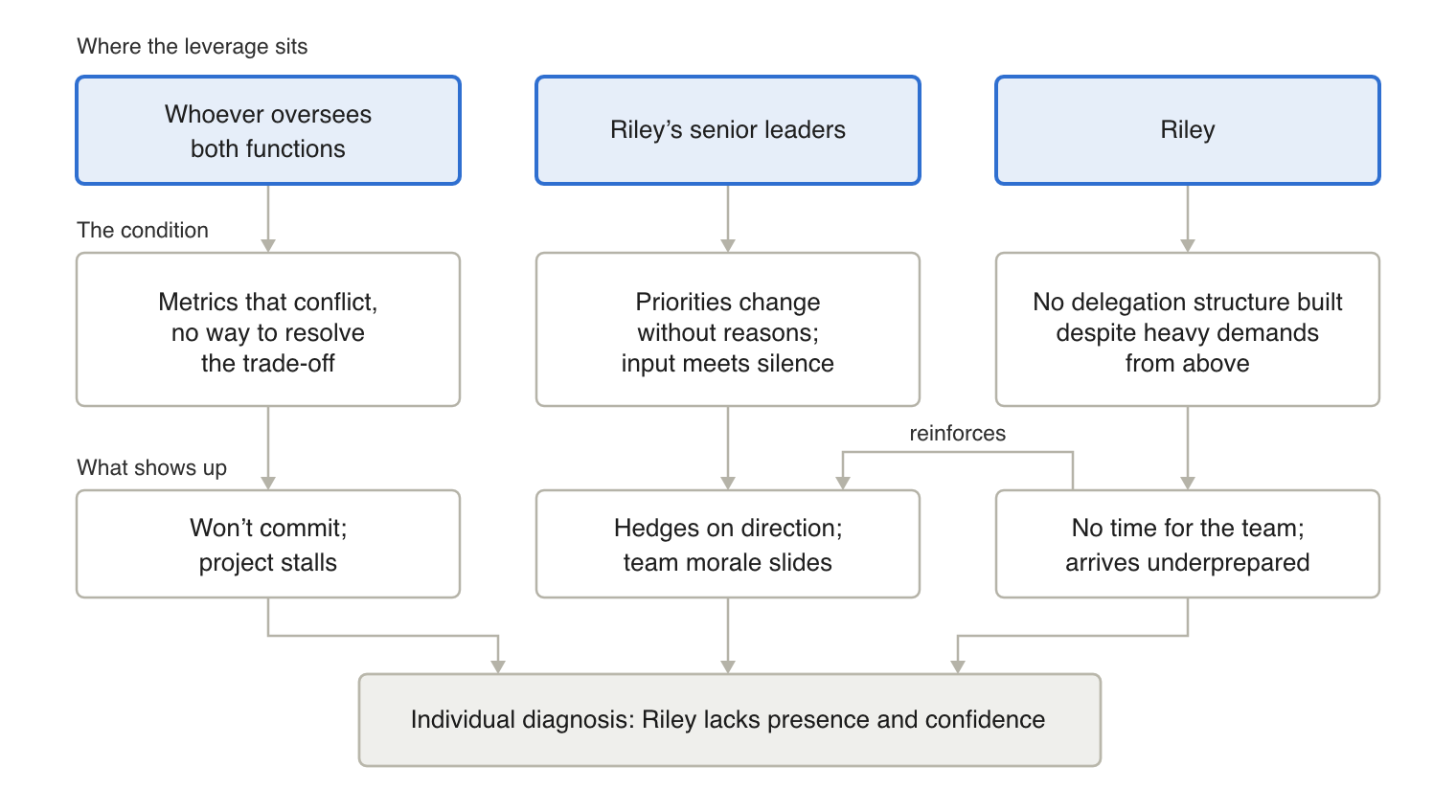
The analysis establishes whether a structural component exists, what it looks like, and which role holds authority and accountability over it.
It also produces a first hypothesis about how the structure generates the behavior. Confirming that hypothesis takes deeper diagnosis beyond what this analysis offers.
The analysis does not establish whether a structure should change. Modifying a system may cost more than the problem itself. The structure may also serve a vital function, and altering it could put that function at risk. For instance, a required approval step might slow work down, yet remain a necessary trade-off for meeting a legal obligation. Navigating these trade-offs is a strategic judgment reserved for whoever holds the authority.
However, once this structural leverage is identified, leaving the problem in place becomes a deliberate choice, rather than an inevitable consequence of systemic oversight. That choice, and presumably the accountability for its outcomes, belongs to the role that holds the authority.
Because Riley's manager lacked insight into the underlying structure, his initial diagnosis placed the burden of the fix entirely with Riley. By contrast, applying this framework isolated the three issues separately, distributing the solutions across three distinct areas based on where the authority actually resides: with whoever oversees both intersecting functions, with senior leadership, and — for what was truly within his control — with Riley himself.